

Growing The Solution Together

At Start Green Co. , we believe that building a sustainable business isn’t just about environmental stewardship, it’s about building a resilient ecosystem. To thrive in the long term, a small business needs strong foundations, clear strategy, and a secure environment to grow.

Welcome to Start Green Co. This is where people turn good ideas into resilient small businesses that do good for the planet and make sense for the bottom line. The world needs your great idea, but let's be honest: trying to launch a business that is both financially viable and genuinely eco-positive can feel overwhelming. You have the passion to do good, but you hit a wall of jargon, unexpected upfront costs, and complexity. We’ve been there. That’s why we created Start Green Co. We are thrilled to introduce a resource built specifically for you, the aspiring entrepreneur, who cares deeply about people and the planet. We are here to simplify the process and show you that you don't have to choose between doing good and making a living. At its core, we help people turn good ideas into sustainable small businesses that do good for the planet and make sense for the bottom line. How do we do it? We believe the best solutions have always been right in front of us. Start Green Co. helps businesses and organizations solve challenges by learning from nature’s 3.8 billion years of history. Our approach isn't theoretical; it's rooted in the proven resilience of natural systems. We blend biomimicry, climate-positive strategy, and systems thinking with measurable outcomes you can trust. We’re passionate about using nature’s approaches to solve real-world business problems. The Small Business Advantage: Practicality Over Preachiness You won't find corporate greenwashing or confusing big-agency price tags here. Our intentional focus on small businesses helps to build smarter, greener, and more resilient systems without the jargon. We are built for small, community-oriented ventures. We combine deep listening with practical solutions that small business owners can implement right away. Our entire approach is founded on six key principles that define how we work with you: Clear communication: We translate big ideas into simple, usable tools. Tangible results: Our clients can see the value in what we create together. Nature-positive expertise: We bring knowledge from biomimetic innovation to circular thinking. Empowerment: Our goal is to leave clients stronger, not dependent. Flexibility: We adjust to your needs, not the other way around. Experience: We bring over 15 years of practical small business expertise to help solve your challenges. Ready to build a business that is ethical, resilient, and future-ready? You're not just starting a business, you're growing a better future. Welcome to Start Green Co.

Introducing the Start Green Co. Resources Library Starting a business is exhilarating. But navigating sustainability, ethical sourcing, and resilient operations often feels overwhelming. The challenge isn't finding information; it's finding good, accessible, and practical information. That's why we're thrilled to introduce the Start Green Co. Resources Library! This library is an essential component for every small business founder. It’s the toolbox we wished we had. It embodies our commitment to accessible sustainability and our core value of empowerment by making sustainable business education open and affordable. Starting a business and integrating sustainability are complex, but they don't have to be confusing. Our library provides clear communication by translating big ideas into simple, usable tools and guides. You’ll find a range of materials for eco-conscious business design, all focused on practical solutions. We celebrate progress, not perfection. The Library gives you bite-sized, actionable resources—checklists, templates, and guides—that you can implement right away. This drives the tangible results you need to see value in what you create. The Library provides free, vetted information that acts as your foundation. This ensures you don't waste time or capital on unproven or overly complex strategies. Our goal is empowerment and we hope to leave clients stronger, not dependent. We equip you with the knowledge to make informed, resilient decisions. What You'll Find Inside The Start Green Co. Resources Library is your go-to place for: Straightforward Worksheets: For integrating sustainability into your business design. Step-by-Step Guides: That simplify complex concepts. Actionable Documentation: Checklists and startup documentation tailored for small eco-conscious ventures. Inspiring Case Studies: Stories that show how small, sustainable businesses achieve Purposeful Profit. Fast Sorting & Search: Content is searchable and categorized by type, making it a central, efficient place for all additional links and materials referred to throughout our course steps. We are passionate about using nature’s approaches to solve real-world business problems, sustainably and elegantly. Visit the Resources Library today (just sign up for a free account to gain access) and find the clarity and tools you need to launch a sustainable business that thrives financially, ethically, and ecologically.
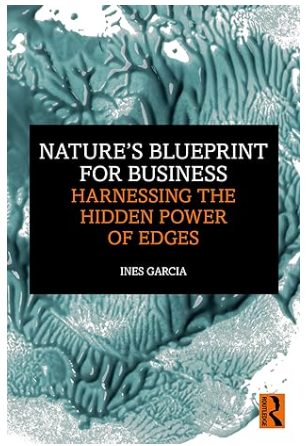
In her latest work, Nature’s Blueprint for Business , Ines Garcia invites us to consider nature-based perspectives for businesses. While Biomimicry has long been used to solve engineering problems, Garcia shifts the focus toward something more abstract and arguably more vital: organizational design and human connection. The core premise of the book is fascinating. Garcia explores the concept of "edge effects" in nature. These are ecological areas where the boundary between two ecosystems (like a forest meeting a meadow) is often more diverse and productive than the center of either. Applying this to business is an incredibly insightful approach to finding solutions and changing perspectives on how businesses currently function and, more importantly, how they can function in more sustainable ways through a more nature-based lens. The author provides truly interesting ideas on how organizations can move away from rigid, siloed structures and toward "permeable boundaries." Her perspective on treating business not just as a machine to be optimized but as a living system to be nurtured is both timely and thought-provoking. The "In Practice" segments are a highlight, offering real-world examples of natural systems and how they can inspire better teams, organizations, and business culture in general. While the conceptual framework is excellent, the execution is occasionally less than perfect. I mention these only in the spirit of thoroughness rather than as a major critique. At times, the writing can feel a bit clunky leading to sentences that require a second read to fully grasp. Each chapter follows a smart and consistent internal structure (starting with a problem, looking at a natural example, and ending with a case study) though the path between chapters can feel a little disjointed. Apart from these quite minor stylistic hurdles Nature’s Blueprint for Business is a refreshing, positive, hopeful, and energizing reading experience. I highly recommend it! Garcia’s clear passion for a more sustainable future is infectious. She is a creative thinker, has a direct and personal approach which includes not only a welcome sense of humor but also frequent insights. I often found myself searching for a pencil to take notes, underline important ideas and examples, and mark sections to come back to. For anyone tired of traditional, "extractive" business models, this book offers a beautiful, insightful alternative that encourages us to look at boundaries (in both business and in ourselves) not as barriers, but as the very places where innovation and life begin.