



Focus On Nature

Life Principles **
Build From the Bottom Up
Use Nested and Modular Components
Build Selectively
Core Ideas
Nature shows us, as new small business founders, that patience is power. Use the following ideas to build your business processes thread by thread, hook by hook. A small, slow, bottom-up approach doesn’t just survive—it creates strength, adaptability, and trust with customers. You don’t need massive budgets or overnight disruption. Instead, consider growing layer by layer into something durable and resilient. Instead of quick wins and top-down control, companies can (and have!) opt to take other approaches.
EXAMPLES OF METHODICAL APPROACHES
- Embed self-repair mechanisms. For example: create customer feedback loops that trigger automatic improvements, or empower staff to fix issues without management approval.
- Build layered trust in risky conditions. For example, in crowded markets, don’t try to “stick everywhere at once.” Instead, build layered customer trust. Start with a small, loyal base, add layers of credibility (certifications, testimonials, local partnerships), and keep expanding outward.
- Assemble modular innovations piece by piece. For example, don’t try to launch the “big version” of your vision right away. Instead, create modular offerings like a workshop, a subscription box, or a small community pilot that can potentially combine into something bigger over time.
- Design teams and systems that interlock naturally. For example, build systems (contracts, payment terms, collaborations with other local sustainable makers, co-ops, or aligned nonprofits) that are lightweight and flexible, so you can connect and disconnect without damage.
- Introduce gradual transitions in markets and partnerships. For example, instead of a big risky market launch, phase your expansion with soft launches, pop-ups, or local trials. Also consider that when onboarding new staff or partners, you can ease them in by starting part-time or project-based and then build long-term commitments.
PRACTICAL STEPS
1. Understand any environmental regulations and compliance issues specific to your sooution. Research and adhere to local, state, and federal environmental laws and permits that are relevant.
2. Incorporate sustainability (environmental and social commitments) into your company's governing legal documents.
3. Continue to review your underlying structures as they are imploemented and ensure they align with your mission and values.
4. Don't forget to leverage your authentic comittment to sustainability in any marketing materials or brand positioning.
Example From Nature
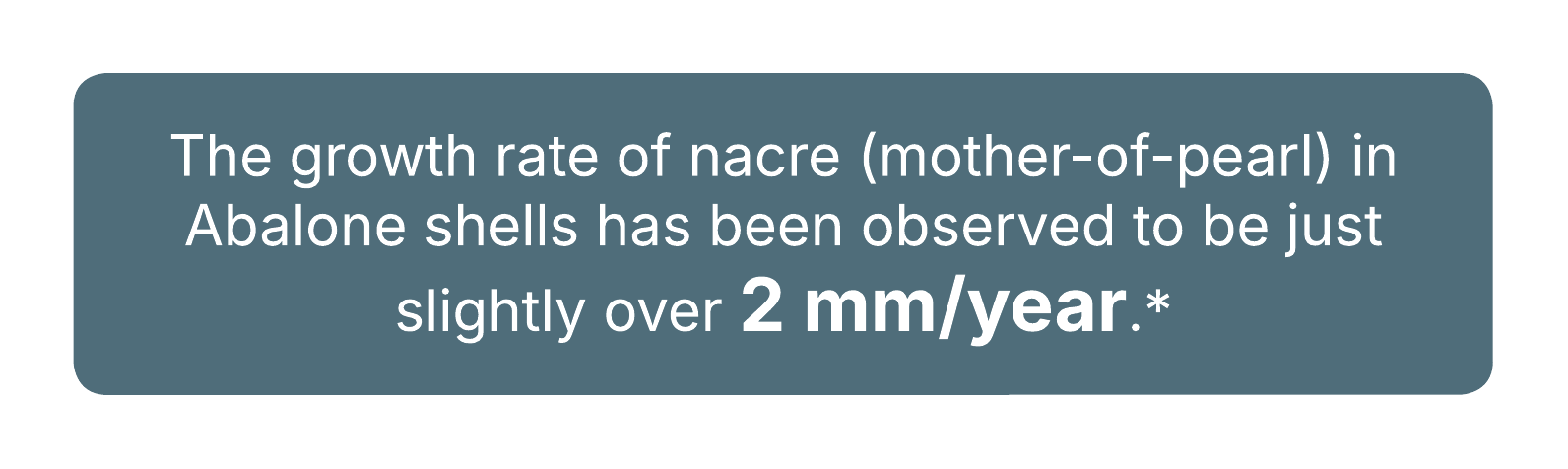
Nacre (also known as mother-of-pearl) is made of flat, microscopic “bricks” of calcium carbonate (aragonite) embedded in a very small amount (less than 5%) of organic material like proteins and chitin that act as a kind of natural “mortar.” These layers stack into a robust, brick-wall pattern.
The mollusk continuously secretes these building materials in a thin layer-by-layer type construction. While calcium carbonate alone is brittle and soft, the composite created ends up being roughly 3,000 times stronger than the mineral base. This slow, methodical process allows less-obvious materials to combine into something extraordinary.
Each layer contributes incrementally and only through patience and structure does nacre gain its strength, toughness, and beauty.
Resource Link
Take a fascinating deep dive into the self-organizing and tightly controlled construction of nacre at this link: https://royalsocietypublishing.org/doi/10.1098/rsta.2015.0449
Nature Based Activity
Celebrate incremental progress by first starting a list of small wins and then scheduling a recurring monthly task on your calendar to review it. Share it with your team and your customers through whatever channel makes sense. To start, list 3-5 small wins from the past month here.
1.
2.
3.
4.
5.
Business Foundations
Core Ideas
This step covers why choosing a legal structure for your new small business is improtant. Especially when it comes to considering structures that have a history of sustainability or social benefits which may be important for your business mission.
BUSINESS STRUCTURE
A registered, professional presence builds credibility with your current and potential customers and the structure you pick affects things like how your business runs every day, how you pay taxes, and whether your personal assets (like your savings or home) are protected. Think of it as a scaffolding for your business that includes overall structur and required registrations/permits while simultaneously influencing everything from bookkeepeing, to marketing, to taxes.
Use the File Download link below for a comparison sheet that considers the pros and cons of various structures.
UNDERSTANDING REGISTRATION
Registering your business legally will depend greatly on what type of structure you choose. The steps can feel overwhelming at first, but if you break them down it becomes much more manageable.
Choose Your Structure
☐ Sole Proprietorship
☐ Partnership
☐ LLC
☐ B-Corp
☐ Nonprofit
Pick & Secure a Name
☐ Search state database (make sure name is available)
☐ Check domain name for website
☐ Run a trademark search (optional, for brand protection)
Register with State
☐ File formation documents (Articles of Organization/Incorporation)
☐ If sole proprietor/partnership → File “Doing Business As” (DBA) if needed
Get an EIN (IRS.gov – Free)
☐ Apply online for Employer Identification Number
☐ Needed for taxes, bank account, employees
Register for Taxes
☐ Sales tax (if selling products)
☐ Employment tax (if hiring)
☐ Any state-specific business taxes
Apply for Licenses & Permits
☐ Local business license (city/county)
☐ Industry-specific permits (food, retail, home-based, etc.)
Open a Business Bank Account
☐ Gather EIN + registration docs
☐ Set up business checking (and savings if possible)
☐ Consider a business credit card
Stay Compliant
☐ Annual filings & fees (for LLCs/corporations)
☐ Renew licenses/permits as needed
☐ Keep personal & business finances separate
Marketing Direction
When deciding on a legal structure for your bsuiness, it may be useful to consider the ways in which that structure could influence the marketing direction and what structure would resonate strongest with your customers.
Some examples include:
- A sole proprietorship may emphasize personal service and authenticity in marketing, while a corporation or B-Corp can market its credibility, governance, and ability to serve larger clients.
- Structures like Benefit Corporations (B-Corps) legally commit to balancing profit and purpose. This could allow for marketing campaigns to emphasize sustainability, ethics, and social impact as core brand messages.
- Partnerships and sole proprietorships often have limited funds, influencing leaner, grassroots marketing strategies (e.g., social media, word-of-mouth). Larger entities with investor backing can afford multi-channel campaigns, branding agencies, and paid advertising.
- Nonprofits are restricted in how they market (e.g., promoting mission over profit, limits on political messaging), which shapes storytelling around donations, grants, and impact.
- A cooperative may highlight community involvement and democratic ownership to attract socially conscious consumers. In contrast, an LLC or C-Corp might frame marketing around growth, scalability, and serving broader markets.
I.T. Security Recommendation
- For most organizations, baseline needs for typical operations would include a standard data privacy policy, a non-disclosure agreement for associates and business partners, an acceptable use policy for anyone accessing organization information assets, and intellectual property protections for trademark, copyright, and confidentiality.
- Also, based on your business’ legal structure and the industry segments, there are likely specific information security compliance requirements.
- Industries such as financial services (FFIEC), health care (HIPAA), retail (PCI), defense contractors (CMMC), and others (e.g., FTC) each have their own specific compliance mandate either by a government agency or an industry consortium.
- For example, PII, PHI, payment card data, and business associate data (i.e., vendors) each may have very specific information security management requirements that require regular and scheduled audits for successful compliance.
- In general, System and Organization Controls 2 (SOC 2) that is defined by the American Institute of Certified Public Accountants (AICPA), is a widely accepted attestation of successful and comprehensive information security control deployment and operation.
- Regardless of industry requirements, a SOC 2 attestation in addition to any of those other industry requirements is viewed positively.
- SOC 2 is principally based on the National Institute of Standards and Technology Cybersecurity Framework (NIST CSF) and also strongly influences the above mentioned industry attestation standards, and is therefore an excellent objective for an organization to aim toward in its information security journey.
Resource Link
Learn more about B Corp certification here: https://www.bcorporation.net/en-us/
And this SBA guide includes lots of details about different legal structures: https://www.sba.gov/business-guide/launch-your-business/choose-business-structure
FIle Download
Find the downloadable file 'Business Legal Structure' on the Resources page.
Business Foundations Activity
This is your time to commit! Choose your business structure and take the next steps to register the business online at your states Secretary of State website.
Business Strucutre:
Business Name: