




Focus On Nature

Life Principles **
Integrate the Unexpected
Use Feedback Loops
Cultivate Cooperative Relationsships
Core Ideas
As you begin Step 10, reflect back to Step 4 where we discussed how to build a Business Ecosystem and how to leverage natures strategies to create a sustaiable small business. Consider how you have been building or contributing to systems that endure, adapt, and give back. Also, review your Impact Thesis (specifcally the outcome) from Step 1 and determine your progress and identify any possible challenges that have not been resolved.
In nature, every system thrives through connection, diversity, adaptability, and reciprocity which are the same traits that define a sustainable business. Together, they form the blueprint for a thriving business ecosystem that creates conditions for life. For example, a healthy business can have the followiing characteristics:
- Connects & collaborates like a forest network
- Diversifies and becomes more resilient like a coral reef
- Self-organizes to increase efficeincy like an ant colony
- Co-creates and shares values (and potential risks) like pollinators
- Regenerates and provides nutriects for others in their ecosystem like a whale fall
- Anchors their community like kelp
- Roots deeply to provide as much stability as possible like prairie grass
As you reflect on your business ecosystem, consider the broad biomimicry-based goal of 'creating conditions for life'. Has your business created conditions for your product/services, your customers, your team, yourslef, and all the other parts of your ecosystem to grow? Consider how to think about each aspect of your business and assign a score. The specific way to measure is dependent on your specific business/industry but the maiin idea remains: how to (as objectively as possible) gauge the impact of your business against the goals you set out to achieve.
Keep in mind that, like nature, nothing is ever 'finished' so take heart if there is not an exact or complete answer to all your challenges. The important takeaway is to determine a way forward, to take the time to reflect on your impact, and consider who and why to do things that align with your values and perpetuate sustainable growth. Businesses can be sustainabile and resilience is a tactic that can be employed to change gracefully while maintaining purpose and integrity.
Example From Nature
In nature, no organism thrives alone. Everything is part of a broader system of exchange, feedback, and renewal.
In the same way, sustainable businesses flourish when they: collaborate, contribute to, and benefit from their ecosystems and evolve in accordance with the changing environment. An example from nature of this integration is Whale Falls.
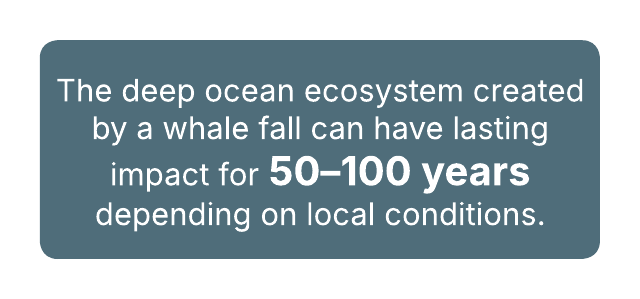
When a whale dies (of natural causes, not harvesting), its body becomes a nutrient-rich ecosystem feeding thousands of species for decades. Because deep-sea environments are typically low in nutrients, a fallen whale becomes an immense, sudden source of organic matter, and triggers a multi-stage ecological succession. In the same way, mature businesses can feed its ecosystem through open knowledge, mentorship, or reinvestment. Nothing is wasted and every cycle fuels the next wave of innovation which can benefit your business.
Resource Link
Frontiers is a large science/research focused publisher with a very wide beadth of information. Take a look here: https://www.frontiersin.org/
Nature Based Activity
List any examples of ways you have been able to 'Integrate the Unexpected' while creating your bsuiness.
1.
2.
3.
Business Foundations
Core Ideas
In this step, you are invited to reflect on your progress so far in this course and in building your business. Some questions to consider:
How can my business stay relevant over time?
What systems will help me continue improving without buring out?
How can my impact extend beyond financial profit towards community, environment, and industry enrichment?
As discussed iin Step 2 (business Goals and Metrics) and in Steps 6 & 7 (Feedback Loops) take time to create and/or review health checks which helps shape long-term strength. These can take many forms such as:
Regularly assessing and reporting on performance
Tracking your environmental and social impact and transparently communicating your progress.
Staying updated on best practices and seeking opportunities to further reduce negative footprint and increase positive impact.
Contributing to a local, sustainable economy through engagement with the community, supporting other businesses, and advocating for policies that align with your values.
Reviewing finances, operations, and customer feedback regularly.
SIGNALS IN THE NOISE
A great way to find focus and maintain direction is to practice observing meaningful signals/ideas from the everyday noise of running the business. In other words pulling the signal from the noise. The term is used in many different scientific fields and can also be used metaphorically to refer to the ratio of useful information to false, irrelevant, or distracting data. Used correctly and measured objectively signals can help you recognize areas where you need to make some changes as well as areas where things are going well and you should lean in.
So then how do we find those signals? By performing an analysis of the business to understand specific thresholds or, in other words, tolerance benchmarks. A threshold is a level below which you’re comfortable with the ebbs and flows of business and don’t have to worry about implementing changes. Decide and review what your thresholds are for each area of your business and revisit business strategy and implement new plans if you have crossed a specific threshold.
Remember that a truly sustainable business is one that learns from itself and evolves in balance with its environment through embracing ideas of continuous improvement.
Marketing Direction
Keep in mind that your message can and should grow as your business does.
As you proceed and learn more about your existing and future customers, be sure to optimize marketing messages and test new strategies that will resonate as strongly as possible.
One useful way to determine this is to understand ommuunity engagment data over time, how you have refined your messaging, what impact those changes have had, and how to move forward.
I.T. Security Recommendation
- Strengthening the B2B and B2C interactions from an operational and information security standpoint will also strengthen those relationships through trust, collaboration, efficiency, and quality. Those are all characteristics that foster long-term and highly profitable relationships.
- Creation of a transparent and collaborative ecosystem also drives continuous improvement for all parties involved and, ultimately, a more secure marketplace.
As your business grows, consider iplementing a more rigourous security posture. This may include things like creating and documenting clear security policies that outline procedures for employees. This helps guard against both intentional and unintentional data risks and can identify other potential vulnerabilities. These policies should cover everything from proper password management to procedures for handling sensitive customer information.
While a do-it-yourself system may have been sufficient in the beginning, a business that has been operating for a few years may need to consider working with an outside security consultancy to perform a comprehensive security audit.
Business Foundations Activity
List 3 real-life lessons learned or examples that relate to how your business supports its broader professional ecosystem.
1.
2.
3.